
This question usually comes up as production starts to climb: is it time to move from manual strapping to a machine? The answer isn't always yes. Investing in a new machine makes sense only when your volume and strapping pattern actually demand it.
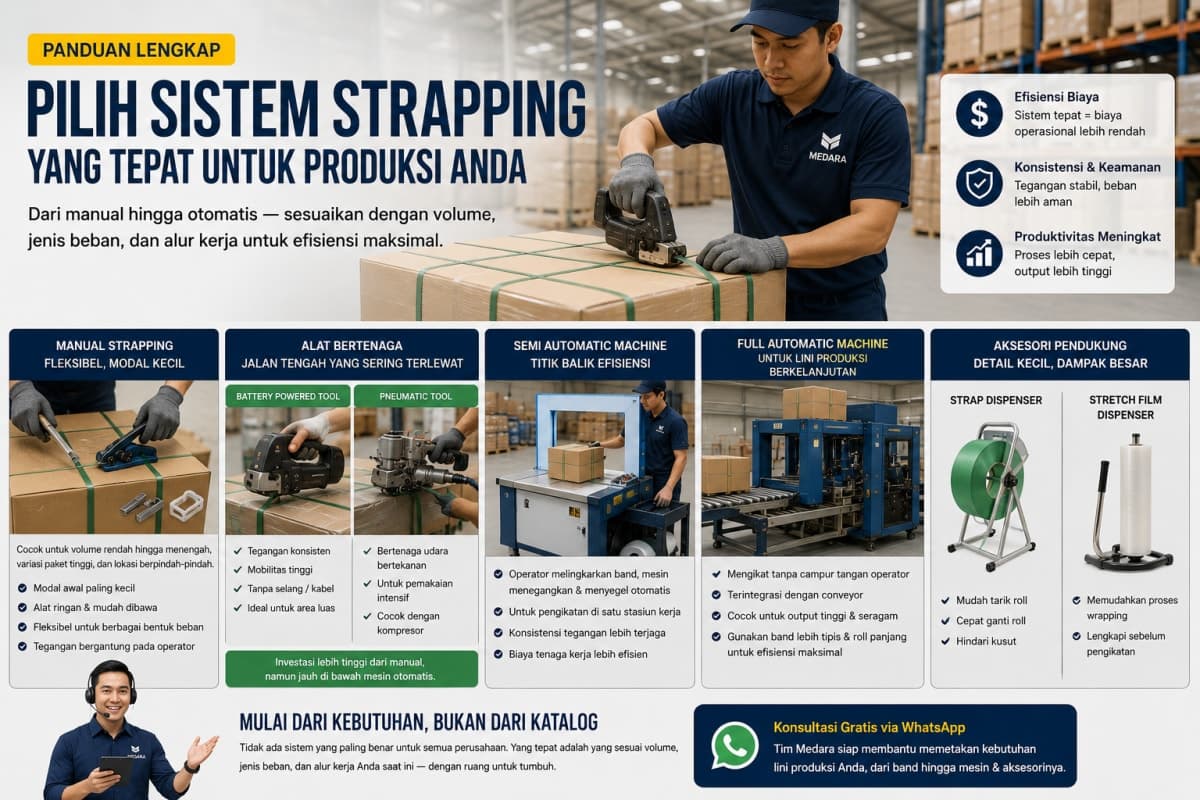
Manual Strapping: Flexible, Low Investment
A manual system uses a tensioner to tighten the band and a sealer to lock the joint with a metal seal or plastic buckle. The upfront cost is the lowest, and the tools can be carried anywhere across the warehouse.
It works well when:
- Strapping volume is low to medium
- Package sizes and shapes vary widely
- Strapping happens at shifting locations rather than one fixed line
The downside is clear: tension depends on the operator, so consistency is hard to maintain once volume rises.
Powered Tools: The Middle Ground Often Overlooked
Before jumping to a large machine, many companies benefit from powered strapping tools:
- Battery powered tool — consistent tension, high mobility, no hoses or cables. Ideal for pallet strapping across a large warehouse floor.
- Pneumatic tool — driven by compressed air, suited to intensive use at sites that already have a compressor line.
Both deliver far more consistent tension than manual, at an investment still well below automatic machines.
Semi-Automatic Machine: The Efficiency Turning Point
A semi-automatic machine works at one fixed table: the operator loops the band, and the machine tensions and seals automatically.
This usually becomes the turning point when:
- Strapping runs continuously at a single workstation
- Tension consistency becomes a requirement, not just a bonus
- Labour cost for manual strapping starts to feel significant
Full Automatic Machine: For Continuous Production Lines
A full automatic machine straps packages with no operator involvement, typically integrated directly with a conveyor. This choice makes sense for high-speed production lines with relatively uniform output — such as corrugated carton box or pulp & paper plants.
Keep in mind that automatic machines usually need thinner bands on long rolls to minimise roll changes. Make sure your band specification matches before the machine goes live.
Don't Forget the Supporting Accessories
Efficiency is often lost not because of the machine, but because of the small things around it. A strap dispenser makes pulling the roll tangle-free and speeds up changes. A stretch film dispenser rounds out the packaging process before strapping. Details like these often decide the real-world speed on the floor.
Start from Your Needs, Not the Catalogue
There is no single right system for every company. The right one matches your current volume, load type, and workflow — with room to grow.
The Medara team is ready to help map out your production line's needs, from bands to machines and accessories. Message us on WhatsApp for a free consultation.