
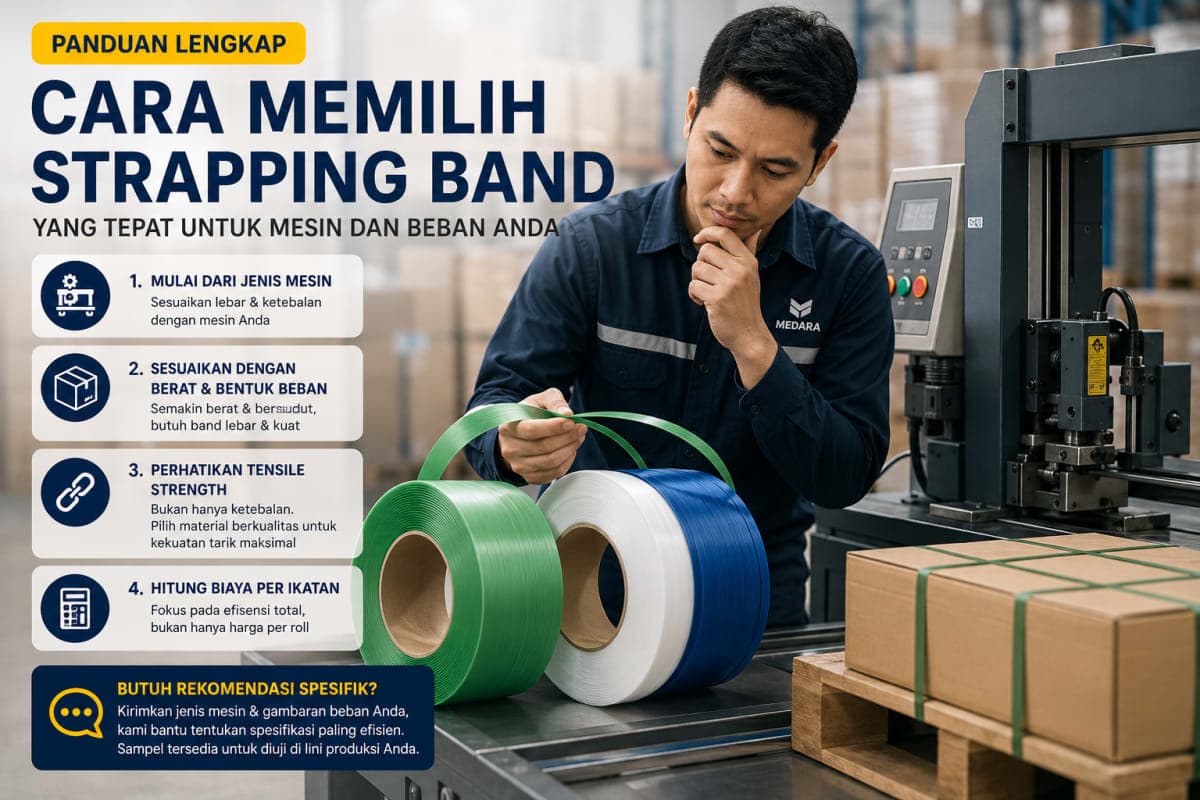
Many companies order strapping band purely out of habit, without checking whether the specification actually matches their machines and loads. The result is one of two problems: bands that keep snapping, or bands that are thicker than necessary — inflating cost with no added benefit.
1. Start with Your Machine Type
The machine is the first deciding factor, because every machine has its own width and thickness tolerance.
- Full automatic machines generally run thinner bands (from 0.50 mm) on long rolls (up to 5,000 m) to minimise roll changes
- Semi-automatic machines use slightly thicker bands (0.55–0.9 mm) on medium-length rolls
- Manual / hand use takes the thickest bands (0.80–0.9 mm) on short rolls, since they are tensioned by hand tools
Forcing a manual-grade band through an automatic machine usually ends with a jammed track.
2. Match the Weight and Shape of the Load
The heavier the load and the sharper its edges, the wider and thicker the band you need.
- Light cartons: a narrow band is enough — prioritise cost efficiency
- Heavy pallets or sharp-edged materials (ceramics, AAC blocks): use a wide band with high tensile strength — consider PET or heavy-duty PP
3. Look at Tensile Strength, Not Just Thickness
Thickness is not the only indicator of strength. Material quality determines the real tensile strength. A cheap band mixed with recycled material can be thick yet still snap under tension.
Every Medara product uses 99% full plastic material — no fillers — so tensile strength stays consistent across every roll. Our heavy-duty variant, for example, is rated up to 330 kgf.
4. Calculate Cost per Strap, Not Price per Roll
A common procurement mistake is comparing price per roll. What matters is cost per strap: a cheap but short roll that keeps breaking ends up more expensive in the long run, adding machine downtime and labour.
Need a Specific Recommendation?
Send our team your machine type and a picture of your loads. We will help you determine the most efficient specification — and provide a sample to test directly on your production line if needed.